Online Therapy for Depression: Does It Work Beyond Mild Cases?
Clinically reviewed by Dr. Lara Foresi
Forty minutes from Dubai Marina to JLT at 6pm, if Sheikh Zayed Road behaves. Then the car park. Then the session, and the drive home. In a week when depression has already cut the day down to work and the sofa, that's usually what gets an appointment cancelled, more than the therapy itself. So online therapy makes obvious practical sense. Whether online therapy for depression holds up for anything heavier than a rough patch is what people want to know before they book, though they don't always ask out loud.
Online therapy for depression holds up better than its reputation
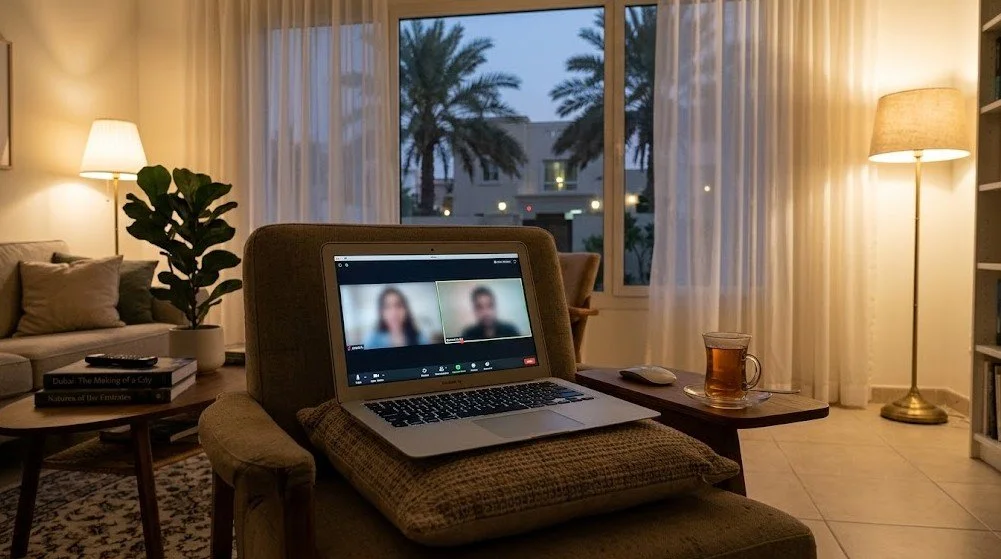
For mild to moderate depression, it's reasonably settled at this point. Research comparing video and face-to-face sessions consistently shows roughly the same improvement in symptoms. People also seem to connect with their therapist on screen about as well as they do in a room. CBT and behavioural activation, two of the most extensively studied depression treatments, are well suited for the online sessions and do not require a shared room at all times. Much of that work is tracking mood, planning one small thing for Thursday, noticing the thought that turns up at 9pm before the evening slides.
Further up the severity scale, there's less research to go on, but that doesn’t mean there is evidence that online therapy fails . So "just mild cases" isn't quite right. "Strongest evidence for mild to moderate" is a more accurate way to put it
Where a screen helps more than people expect
Some people find it easier to talk from their own sofa. In Dubai, your colleague might live two floors down and your kids might share a classroom with your neighbour's. Being spotted walking into a clinic is a real worry.
Consistency is important when dealing with depression, and weekly online sessions are easier to keep:
No commute in August, when 45°C makes leaving the apartment feel like a project
Shift rosters that change every fortnight, or a manager in London who books calls for 7pm Dubai time
The low-energy days. Those are what usually kill an in-person appointment, and often when a session would have helped most
When in-person care or psychiatry is the better call
A good clinician won't sit on this. If weekly video sessions aren't going to be enough, you should hear it in the first session or two, not in month four.
Depression that has stopped someone going to work, eating properly or getting out of bed, impacting their ability to independently function well in everyday life, is a different situation. Depending on the person's symptoms and history, this may include input from a psychiatrist and medication as part of the treatment plan.It usually needs closer contact, and often a psychiatrist alongside the therapist. Only a psychiatrist can start and monitor medication, and quite a few people would rather sit across a desk for that first consultation. Psychotic symptoms, or any history of bipolar disorder, mean specialist psychiatric assessment is important from day one. Not sure where you fall? The signs that a GP or therapist isn't enough are worth reading first.
Home can be the obstacle too. With thin walls or a partner who's part of the problem, the clinic room is sometimes the only private hour in someone's week.
If you're having thoughts of ending your life, or you don't feel you can keep yourself safe, please don't wait for a scheduled video call. In the UAE, call 998 for an ambulance or go to your nearest emergency department.
How the decision actually gets made
Nobody should have to diagnose themselves into the right format. A first session, online or in person, usually covers how long the low mood has been there, what it's affecting (sleep, appetite, work, relationships), what's been tried before, and whether there's any risk that changes the plan.
The answer might be carrying on online, moving to the clinic, bringing in a psychiatrist, or a mix. Some people start in person and go online once things are moving.
At Thrive, online sessions are run by the same DHA-licensed clinicians who see clients at the JLT and Dubai Sports City clinics, across 17 languages. Switching formats doesn't mean starting again with someone new.
So is online therapy enough?
For a lot of people, yes. For some, not on its own. Not knowing which group you're in is normal. It's still not a reason to sit on it for another month. Two weeks or more of low mood is enough to book an initial consultation with Thrive, online or at the clinic, and the first session can sort out the format.