Online Anxiety Tests vs. In-Person Assessments — What’s the Difference?
Anxiety is a common human experience, a feeling that often signals potential danger or stress. It's that knot in your stomach before a big presentation, or the racing thoughts when you're facing a difficult situation. While a certain level of anxiety can be motivating or protective, for some, it becomes a persistent and overwhelming feeling that interferes with daily life.
It's important to recognize that anxiety is more than just feeling worried; it can manifest in various ways, affecting your thoughts, emotions, and physical body. These feelings can range from mild unease to intense panic. When these experiences become frequent and difficult to manage, they can significantly impact your well-being and your ability to engage in activities you once enjoyed.
Consider these common ways anxiety can show up:
Physical Symptoms: This might include a racing heart, shortness of breath, muscle tension, fatigue, or digestive issues.
Mental and Emotional Symptoms: You might notice persistent worry, difficulty concentrating, irritability, restlessness, or a sense of dread.
Behavioral Changes: Some people find themselves avoiding situations that trigger their anxiety, leading to a more limited life.
It's also worth noting that anxiety disorders are quite prevalent. For instance, recent data has shown a notable increase in reported symptoms of anxiety and depressive disorders, particularly in the wake of significant global events (WHO reported a 25% increase in anxiety/depression prevalence in the first year of COVID). This highlights how common these experiences are and that you are certainly not alone if you are struggling.
Understanding the nuances of your own anxiety is the first step toward finding effective ways to manage it. It's about recognizing the patterns and learning what works best for you.

When anxiety becomes a significant challenge, seeking support is a sign of strength. There are many paths to feeling better, and professional guidance, such as through anxiety therapy, can make a substantial difference in regaining a sense of calm and control.
Online Anxiety Tests: Convenience and Accessibility
In today's fast-paced world, finding time for your mental well-being can feel like a challenge. That's where online anxiety tests come into play. These digital tools offer a way to explore your feelings about anxiety from the comfort of your own home, whenever it suits you.
How Online Tests Work
Many online anxiety tests are designed to be straightforward. You'll typically encounter a series of questions or statements about your thoughts, feelings, and behaviors. Some online tools are adapted from validated questionnaires. You'll be asked to rate how often you experience certain symptoms or how much they bother you over a specific period, like the past week or two. Some popular examples include questionnaires that help screen for general anxiety or specific types of anxiety disorders. A common type you might encounter is a quick anxiety test, which aims to give you a general idea of your current anxiety levels.
Pros of Online Anxiety Tests
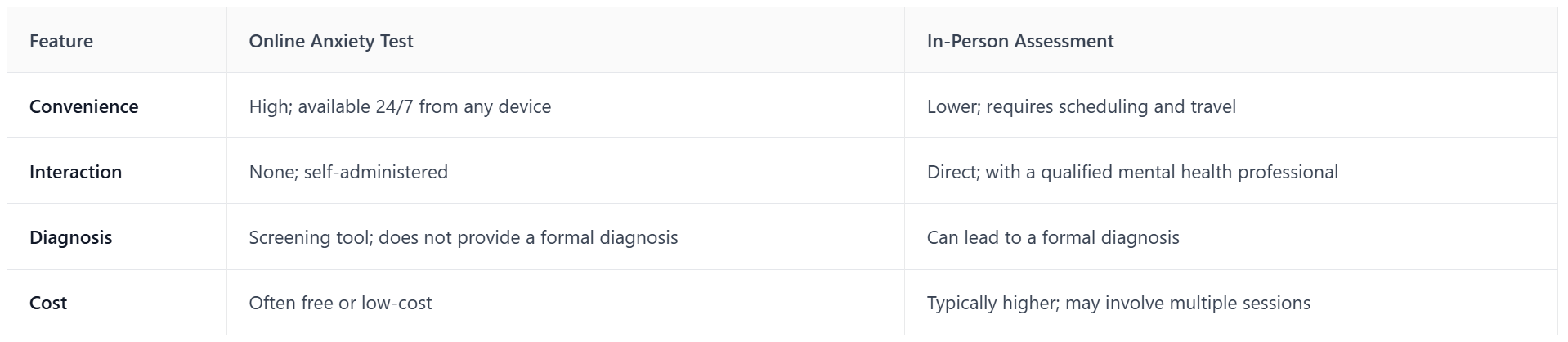
Accessibility: You can take these tests anytime, anywhere, without needing to schedule an appointment or travel. This is a big plus if you have a busy schedule or find it difficult to leave home.
Anonymity: For some, taking a test online feels less intimidating than speaking with someone face-to-face. It can be a private first step in understanding what you're experiencing.
Cost-Effectiveness: Often, these tests are free or low-cost compared to a professional assessment. They can be a good starting point without a significant financial commitment.
Immediate Feedback: Many online tests provide instant results, giving you a preliminary understanding of your anxiety symptoms.
Cons of Online Anxiety Tests
Limited Scope: Online tests are typically screening tools. They can indicate the possibility of anxiety but cannot provide a formal diagnosis.
Lack of Personal Interaction: These tests can't account for the nuances of your personal history, life circumstances, or non-verbal cues that a trained professional would observe.
Potential for Misinterpretation: Without a professional to guide you, it can be easy to misinterpret the results or worry unnecessarily.
While online tests can be a helpful starting point for self-reflection, they are not a substitute for a professional evaluation. Think of them as a signpost, pointing you in a direction, rather than a definitive map.
Here's a simple comparison of what you might expect:
In-Person Anxiety Assessments: Professional Evaluation
When you're trying to figure out what's going on with your anxiety, sometimes the most helpful step is to talk with a professional face-to-face. This is where in-person anxiety assessments come in. Think of it as a more thorough check-up for your mental health, done by someone trained to understand the complexities of anxiety.
The Process of In-Person Assessment
An in-person assessment usually starts with a conversation. A mental health professional, like a psychologist or a licensed therapist, will talk with you about what you're experiencing. They'll ask about your feelings, thoughts, and behaviors, and how these affect your daily life. This isn't just about ticking boxes; it's about building a picture of your unique situation. They might use structured interviews, where they ask specific questions, or more open-ended discussions to get a full understanding. Sometimes, they'll ask you to fill out questionnaires, similar to what you might find online, but they can also observe your reactions and body language during the session. This direct interaction helps them notice subtle signs that might be missed otherwise. For example, when discussing something like social anxiety disorder treatment, a professional can gauge your comfort level in real-time, which is hard to do through a screen.
Pros of In-Person Assessments
Direct Observation: A professional can observe your non-verbal cues, such as eye contact, tone of voice, and body language, which can provide additional insights into your anxiety.
Deeper Exploration: Face-to-face interaction allows for more in-depth questioning and follow-up, helping to uncover the root causes and specific triggers of your anxiety.
Building Rapport: Developing a trusting relationship with your assessor can make it easier for you to open up and share sensitive information.
Comprehensive Evaluation: Professionals can integrate various assessment methods, including clinical interviews, standardized tests, and behavioral observations, for a more complete picture.
Cons of In-Person Assessments
Scheduling Challenges: You'll need to schedule appointments, which can be difficult if you have a busy work or personal life.
Logistical Hurdles: This method requires travel to a clinic or office, which can be a barrier for those with mobility issues or living in remote areas.
Potential for Higher Cost: In-person assessments may sometimes be more expensive due to the time involved and the resources required.
Anxiety About the Appointment: For some, the idea of a face-to-face evaluation can itself be a source of anxiety.
While online tools can be a good starting point for mental health screening, they often can't replace the nuanced understanding a trained professional gains through direct interaction. Recognizing mental health warning signs is the first step, but a thorough assessment is key to effective treatment planning.
While there can be similarities in reported symptoms between in-person and telehealth (remote) assessments, the direct interaction in an in-person setting commonly offers unique advantages for detailed evaluation.
Key Differences: Online vs. In-Person
When you're thinking about how to get an anxiety assessment, you've got two main paths: online tests or in-person evaluations. They both aim to help you understand what's going on, but they go about it in pretty different ways.
Online tests are super convenient. You can do them right from your couch, whenever it fits your schedule. They often use questionnaires and self-report measures to get a sense of your symptoms. It's a good way to get a general idea or to start the process if getting to an in-person appointment is tough.
In-person assessments, on the other hand, involve meeting with a professional face-to-face. This allows for a more direct interaction. Your clinician can observe your body language and other non-verbal cues, which can add a lot of detail to what you're saying. They might also use a wider range of assessment tools and techniques that can't be done remotely.
Here’s a quick look at some of the main distinctions:
Observation: In-person allows for direct observation of behavior and non-verbal cues. Online tests rely solely on what you report.
Interaction: Face-to-face sessions allow for immediate follow-up questions and a more dynamic exchange. Online interactions can sometimes feel more static.
Environment: An in-person assessment usually happens in a private clinical setting. An online test is taken in your own environment, which might have its own distractions.
Scope: While online tests can be great for screening, in-person assessments often provide a more thorough and nuanced picture, especially for complex situations.
It's important to remember that while online tests can offer a helpful starting point, they don't replace the detailed evaluation a trained professional can provide in person. The nuances of human interaction and observation are hard to replicate digitally.
Think of it this way: an online test might give you a good map of the terrain, but an in-person assessment is like having a guide who can point out specific landmarks and hidden paths you might have missed on your own. The level of detail and personal connection can be quite different.
When to Choose Which Method
Deciding between an online anxiety test and an in-person assessment really comes down to what feels right for you and what you need at this moment. Think of it like choosing between a quick online check-up for a minor concern versus a full physical with your doctor. Both have their place.
Online tests can be a fantastic starting point, especially if you're feeling hesitant about seeking professional help or if you have a lot on your plate. They offer a private, convenient way to get a preliminary idea of what might be going on. If you're experiencing mild to moderate symptoms and just want to understand them better, or if you're looking for a low-barrier way to begin exploring your mental well-being, an online test might be just the ticket. It's also a good option if you live far from mental health services or have a very demanding schedule that makes in-person appointments difficult.
However, if your anxiety feels more intense, if it's significantly impacting your daily life, or if you've tried to manage it on your own without much success, an in-person assessment is likely the better route. A professional can observe subtle cues, ask clarifying questions in real-time, and conduct a more thorough evaluation that considers your unique history and circumstances. This is particularly important if there might be other underlying conditions that need to be considered alongside anxiety. The depth of understanding you can gain from a face-to-face interaction with a trained professional is often unmatched.
Here’s a simple way to think about it:
Choose Online If:
You want a quick, private way to screen for anxiety symptoms.
You have limited time or live in an area with few local resources.
You are experiencing mild symptoms and want to explore potential next steps.
You are feeling apprehensive about an in-person visit.
Choose In-Person If:
Your anxiety is severe or significantly interfering with your life.
You suspect there might be other mental health concerns.
You want a comprehensive evaluation and a personalized treatment plan.
You benefit from direct interaction and real-time feedback.
Sometimes, a combination approach can also be very effective. You might start with an online screening and then follow up with an in-person appointment to discuss the results and create a tailored plan. The most important thing is to find a path that feels manageable and supportive for you.
The Importance of Professional Diagnosis and Treatment
While online tests can offer a helpful starting point, they are not a substitute for a professional evaluation. Think of them as a preliminary screening, like checking your tire pressure before a long road trip. It gives you an idea of what might be going on, but it doesn't tell you the whole story or what specific actions to take.
A proper diagnosis from a qualified mental health professional is the bedrock upon which effective treatment is built. Without it, you might be treating the wrong issue, or worse, delaying the care you truly need. Professionals use a variety of tools, including structured interviews, observation, and validated assessment measures, to get a complete picture of your mental health. They consider your personal history, your current life circumstances, and how your symptoms are affecting you in real-time.
Here's why this professional step is so important:
Accuracy: Professionals are trained to differentiate between various conditions that might share similar symptoms. For example, what feels like anxiety could sometimes be related to other physical health issues or different mental health conditions.
Personalized Treatment Plans: Based on a thorough assessment, a clinician can develop a treatment plan tailored specifically to your unique needs. This might involve therapy, medication, lifestyle changes, or a combination of approaches.
Monitoring Progress: A professional can track your progress over time, making adjustments to your treatment as needed. This ensures you're moving in the right direction and getting the most benefit from your care.
Ruling Out Other Conditions: Sometimes, symptoms can be caused by underlying medical issues. A professional assessment can help identify or rule out these possibilities.
Relying solely on self-administered online tests can lead to misinterpretation of results. It's easy to overemphasize certain symptoms or overlook others when you don't have a trained eye guiding the process. This can result in unnecessary worry or a false sense of security.
Ultimately, seeking professional help means you're taking a significant and positive step toward understanding and managing your well-being. It's about getting the right support, at the right time, from the right people.
Making Your Choice
So, you've looked at online anxiety tests and in-person assessments, and now you're trying to figure out what's best for you. It's not a simple 'one size fits all' situation, is it? Online options give you that easy access and convenience, letting you get started from your own couch. That's pretty great, especially if getting to an appointment is tough. On the other hand, the in-person route, with a professional right there, can offer a deeper look and more direct interaction. Think about what feels right for your situation, what you can manage, and what kind of support you think you need. Both paths can lead you toward understanding yourself better and finding the help you're looking for.